What If We Returned to Our Homeland?
3/23/20269 min read
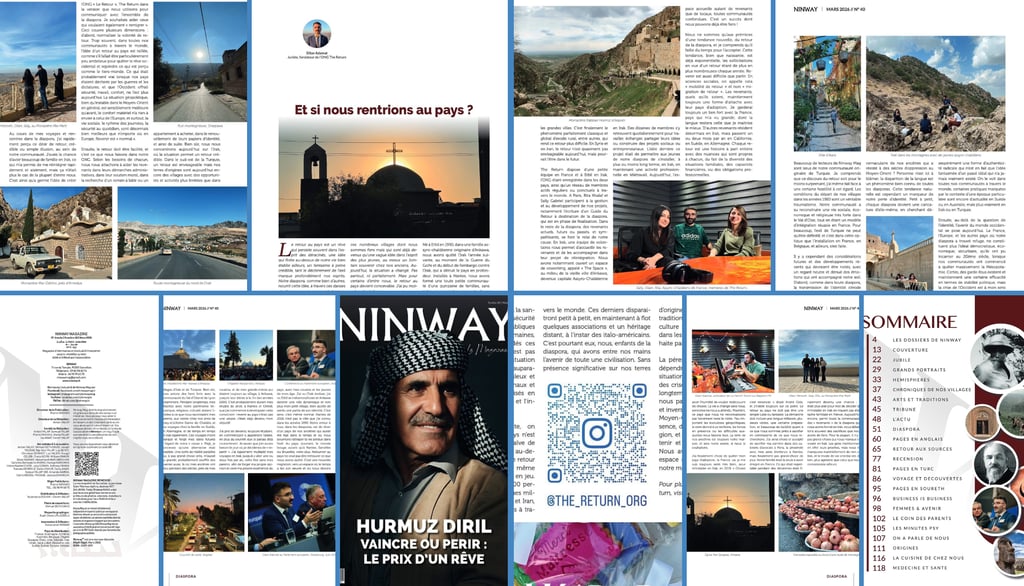
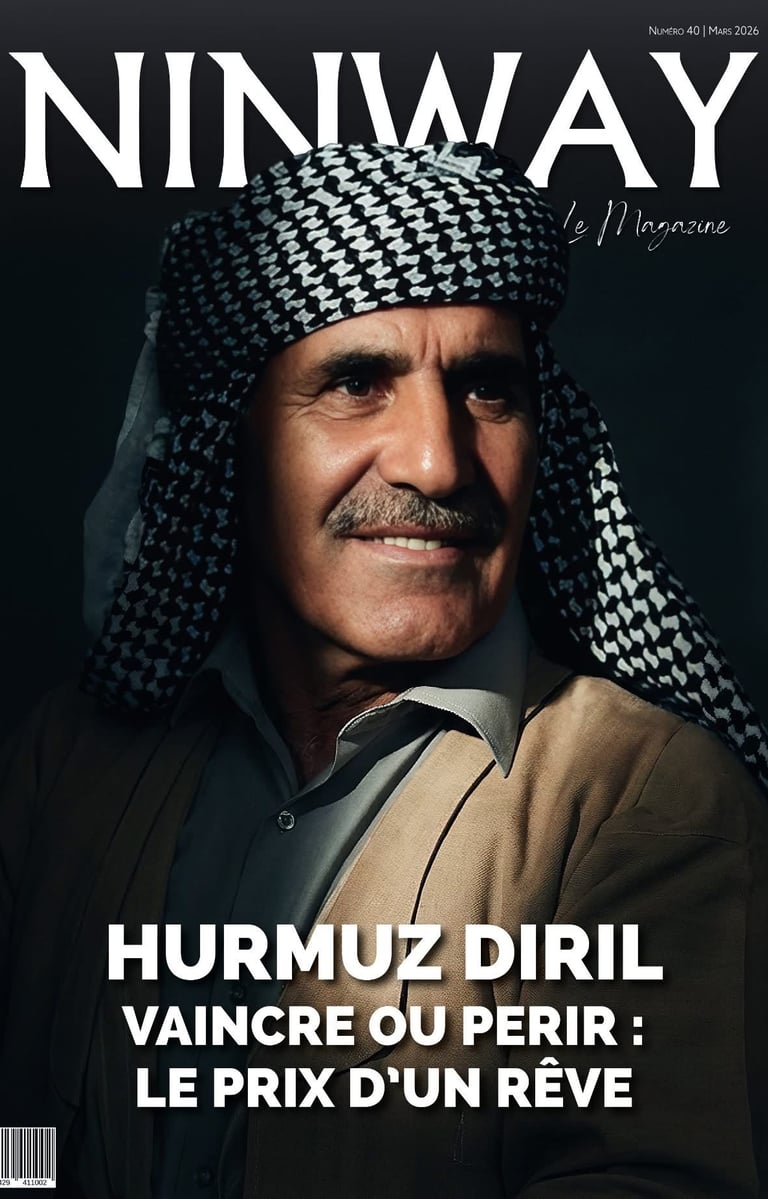
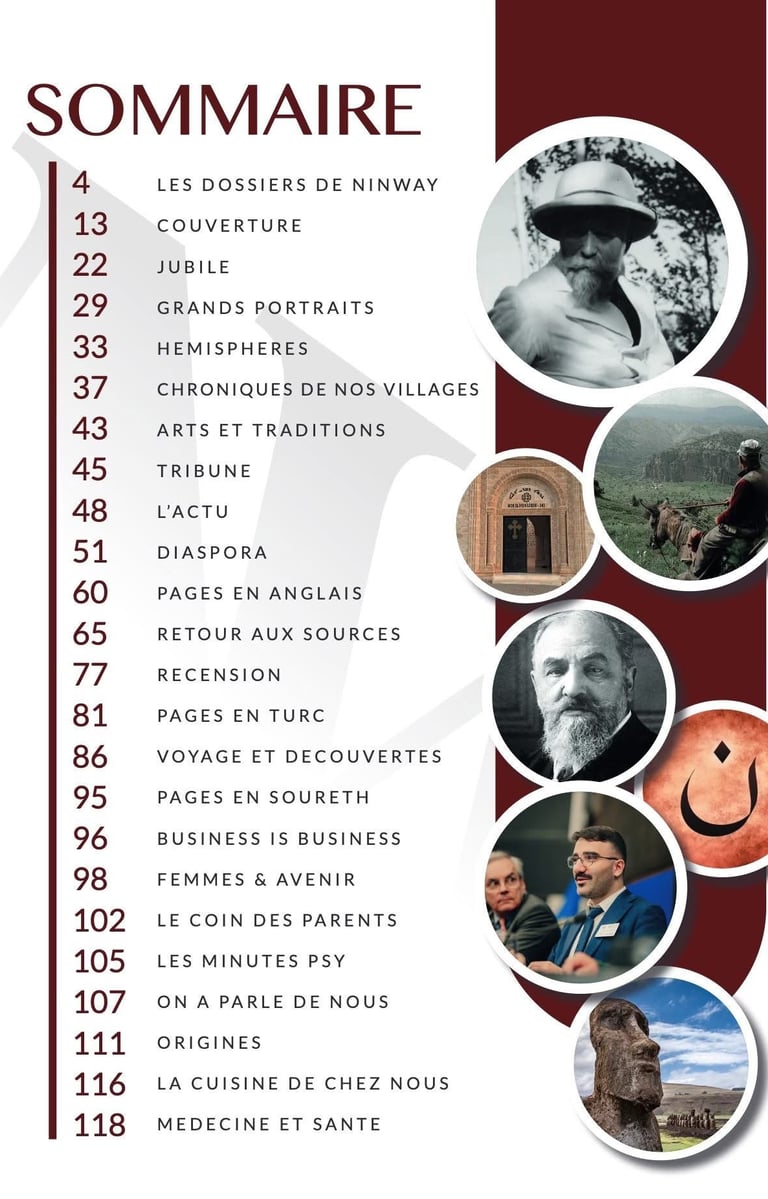
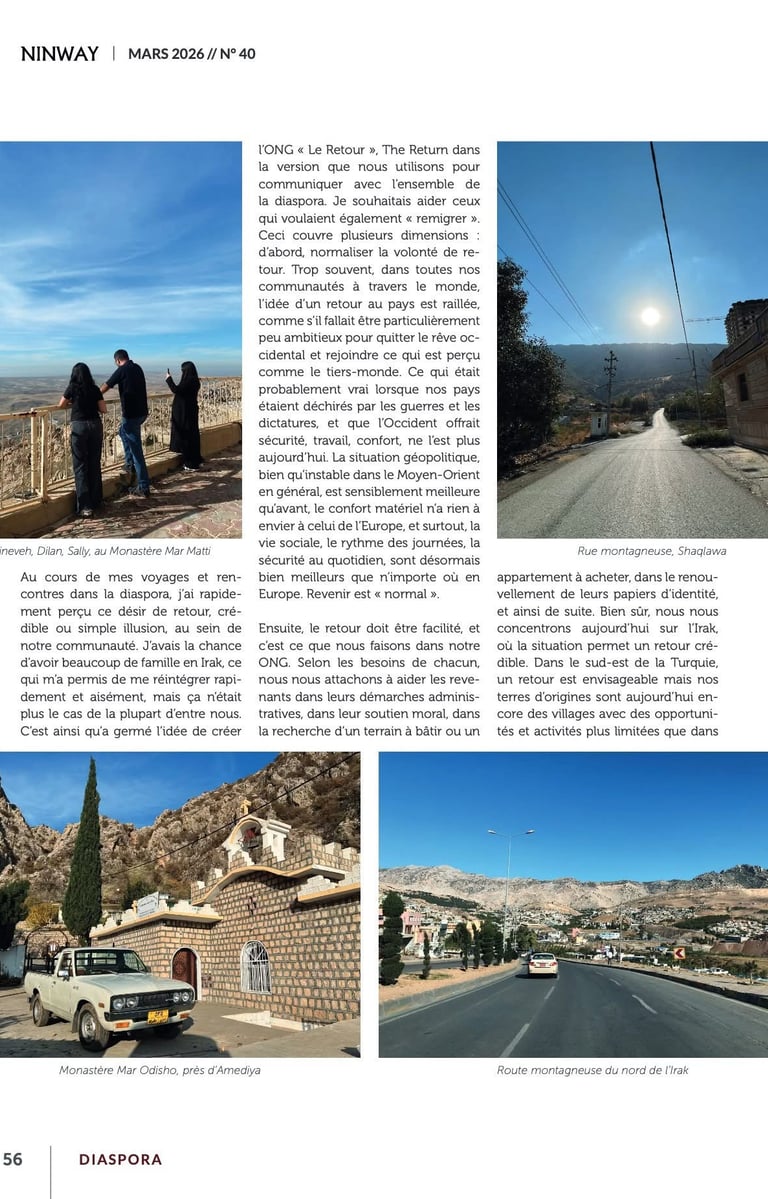
The article below is an AI-generated translation of the original French version published by Ninway Magazine (March 2026, issue 40, see below).
Returning home is a dream that often lingers in the minds of those who have been uprooted, an idea that hovers above our well-established lives elsewhere, a barely believable fantasy, so deeply does the trauma of exile mark our minds. Our diaspora, like many others, nurtures this idea through the dances and songs we preserve, through the many villages we take pride in but which have already become little more than a vague notion in the minds of the younger generations, at best a distant memory for our elders. Today, the situation has changed. Not everywhere, nor perfectly. But for some of us, returning home has become conceivable. I myself have been able to achieve it.
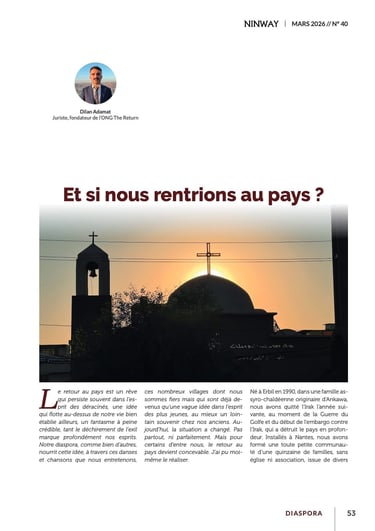
Born in Erbil in 1990, into an Assyro-Chaldean family originally from Ankawa, we left Iraq the following year, at the time of the Gulf War and the beginning of the embargo against Iraq, which deeply devastated the country. Settled in Nantes, we formed a very small community of about fifteen families, without a church or an association, originating from various villages in Iraq and Turkey. Of course, we maintained strong ties with the communities of Val d’Oise and Lyon in particular. For a long time, my connection to our linguistic, religious, and cultural heritage was limited to what my parents told me, to visits to our friends in Soisy and at Notre-Dame-de-Chaldée, and to trips to family members in Sweden, Germany, and occasionally Iraq as well. These trips left a lasting impression on me and shaped my future views regarding our “cause.” Even then, I sensed that an alternative was possible. A sort of parallel reality which, with only slight differences, would have seen me grow up, and likely suffer through wars as well, where my ancestors lived for centuries, near my cousins and my grandmothers who remained in the village, in Ankawa, until their passing in the late 2000s. It was probably during my law studies in Nantes and Créteil that I began to develop this conviction: returning home was not a utopia, it had already become my goal.
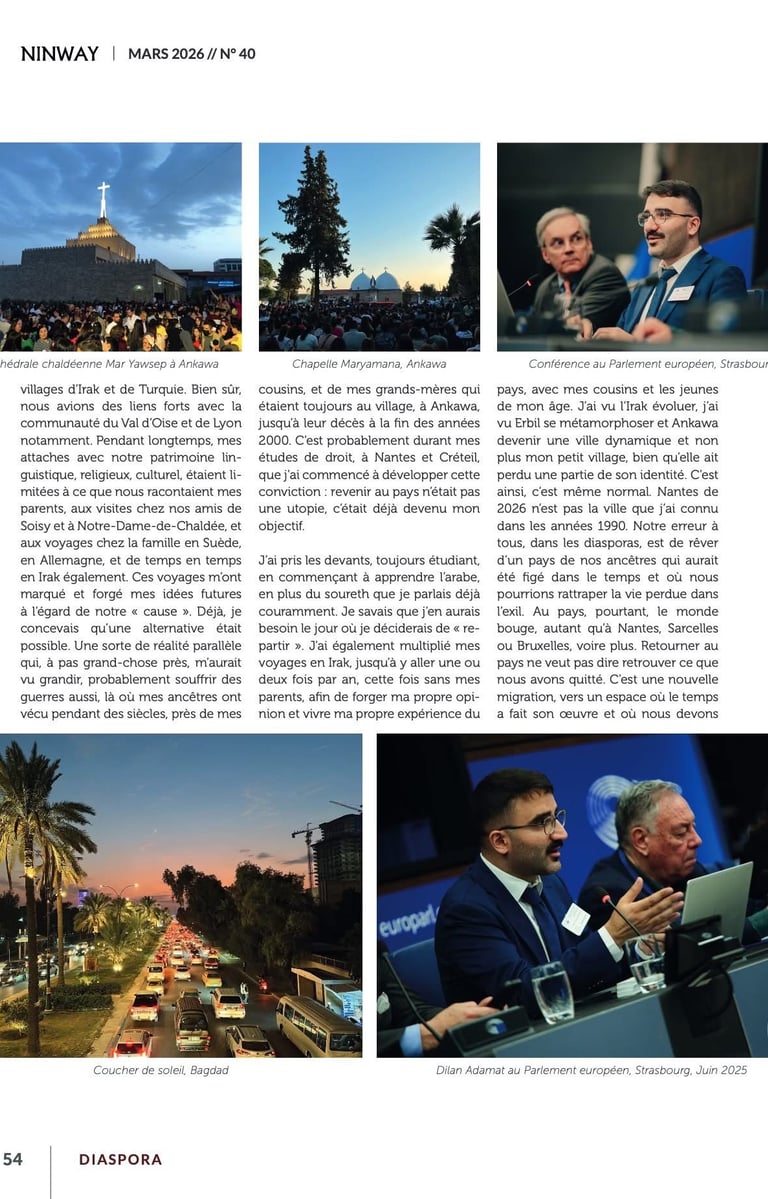
I took the initiative, while still a student, by beginning to learn Arabic, in addition to Sureth, which I already spoke fluently. I knew I would need it the day I decided to “leave again.” I also increased my trips to Iraq, going once or twice a year, this time without my parents, in order to form my own opinion and live my own experience of the country, alongside my cousins and people my age. I saw Iraq evolve, I saw Erbil transform, and Ankawa become a dynamic town rather than the small village I once knew, although it lost part of its identity. That is simply how things are, and it is even natural. Nantes in 2025 is not the city I knew in the 1990s. Our shared mistake, across all diasporas, is to dream of our ancestors’ homeland as frozen in time, a place where we could reclaim the life lost in exile. Yet in our homeland, the world moves on, just as much as in Nantes, Sarcelles, or Brussels, if not more. Returning home does not mean rediscovering what we left behind. It is a new migration, toward a place where time has taken its course and where we must have the humility to rediscover things anew. Life has changed without us; no one has been waiting for us. And yet, this country we may not fully recognize remains ours. Regardless of geopolitical developments, the name given to this territory, the forces at play, or the challenges we face, the land of our ancestors is still our home and will be our future, if we choose it.
I ultimately chose to leave my adopted country, France, where I had always felt very comfortable, to settle in Iraq in 2019. “To choose is to renounce,” as André Gide said, and I always emphasize this point. Returning home must not be a mere whim or fantasy. The process requires long reflection, several visits, a certain degree of preparation, and a great deal of lucidity about what we are willing to sacrifice in exchange for what we seek. I thus chose and accepted to give up my career in law firms in Paris, the closeness of my childhood friends in Nantes, but ultimately not much more. Our family was the only one to have emigrated to France. What had been a disadvantage for decades became a benefit: it was easier for me to decide to settle in Iraq without strong family ties in France. Even today, among the entire community of “returnees” from the diaspora that we have formed in Iraq, we often discuss the sacrifices we have made. For most of us, there is very little we miss in living in Iraq. People do mention their loved ones, but materially we lack nothing in Iraq, and the Eastern way of life is by far more pleasant than what we experienced elsewhere.
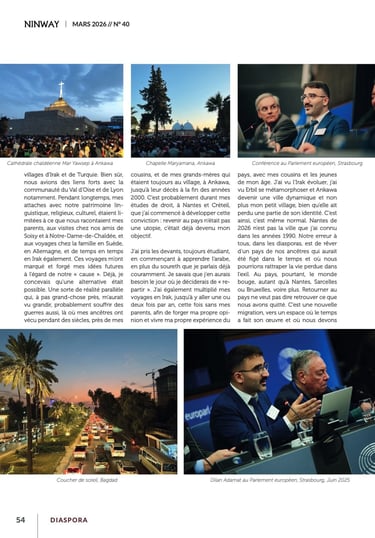
During my travels and encounters within the diaspora, I quickly perceived this desire to return, whether realistic or illusory, within our community. I was fortunate to have a large family in Iraq, which allowed me to reintegrate quickly and easily, but this was no longer the case for most of us. This is how the idea of creating the NGO “Le Retour,” The Return in the version we use to communicate with the entire diaspora, came about. I wanted to help those who also wished to “re-migrate.” This involves several dimensions: first, normalizing the desire to return. Too often, in all our communities around the world, the idea of returning home is mocked, as if one must be particularly lacking in ambition to leave the Western dream and go back to what is perceived as the third world. While this may have been true when our countries were torn apart by wars and dictatorships, and when the West offered security, jobs, and comfort, it is no longer the case today. The geopolitical situation, although still unstable in the Middle East as a whole, is significantly better than before, material comfort is comparable to that of Europe, and above all, social life, the rhythm of daily life, and everyday security are now far better than anywhere in Europe. Returning is “normal.”
Secondly, returning must be facilitated, and this is what we do within our NGO. Depending on individual needs, we assist returnees with administrative procedures, provide moral support, help them find land to build on or an apartment to purchase, renew their identity documents, and so on. Naturally, we currently focus on Iraq, where the situation allows for a credible return. In southeastern Turkey, a return is conceivable, but our ancestral lands remain villages with more limited opportunities and activities compared to major cities. This is ultimately the well-known global phenomenon of rural exodus, among others, which makes return more difficult. In Syria and Iran, return is almost impossible today, but it may become possible in the future.
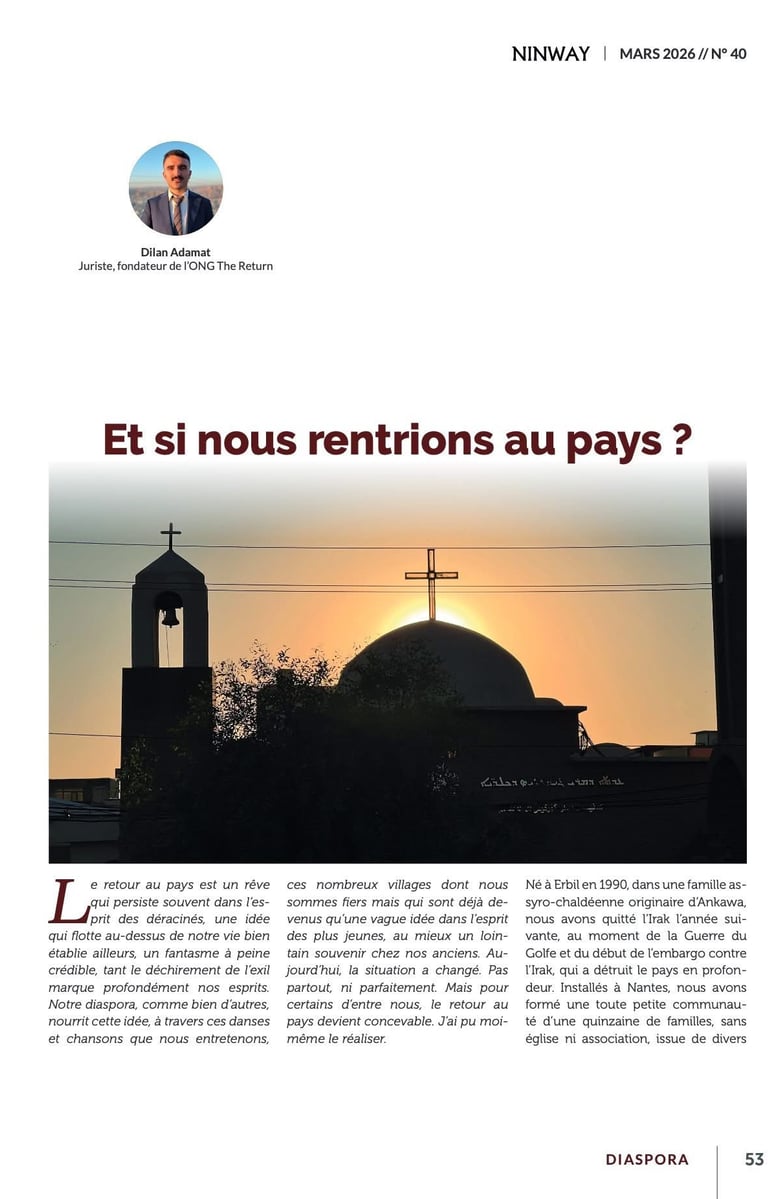
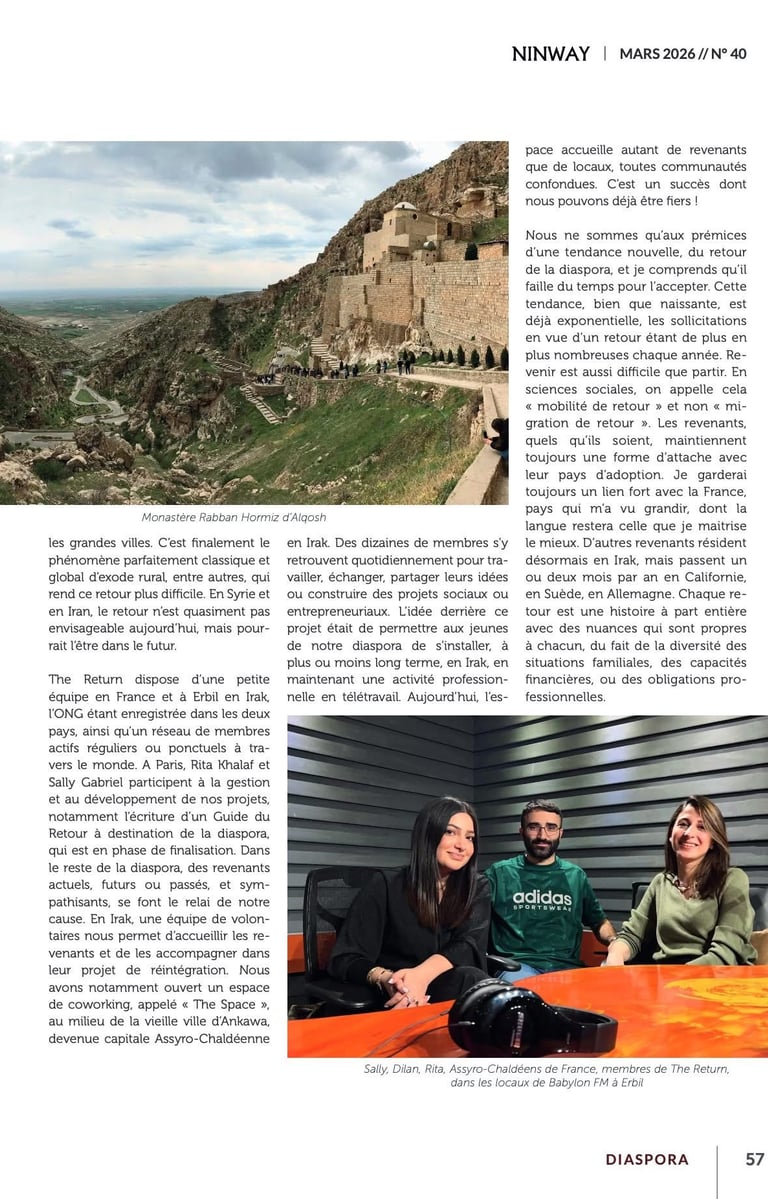
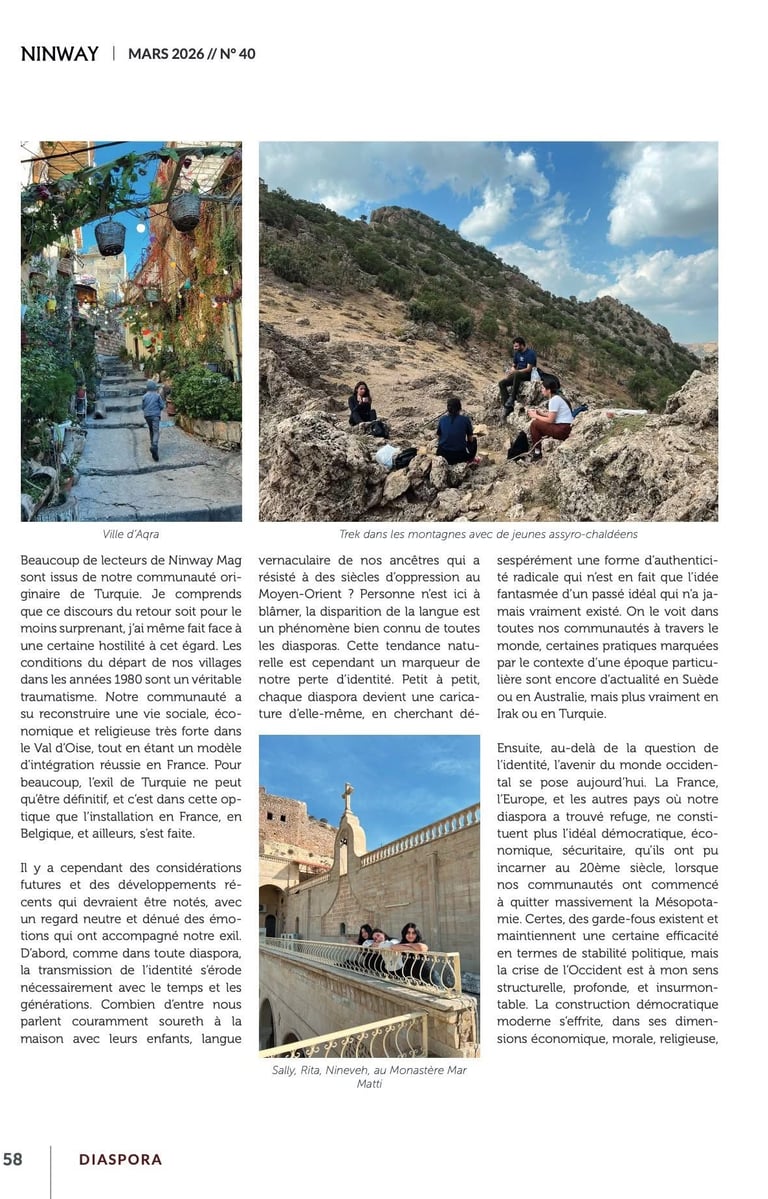
The Return has a small team in France and in Erbil, Iraq, with the NGO registered in both countries, as well as a network of active members, either regular or occasional, across the world. In Paris, Rita Khalaf and Sally Gabriel contribute to the management and development of our projects, notably the writing of a Return Guide for the diaspora, which is nearing completion. Throughout the diaspora, current, future, or past returnees, as well as supporters, help promote our cause. In Iraq, a team of volunteers allows us to welcome returnees and support them in their reintegration projects. We have notably opened a coworking space, called “The Space,” in the heart of the old town of Ankawa, which has become the Assyro-Chaldean capital in Iraq. Dozens of members gather there daily to work, exchange ideas, and develop social or entrepreneurial projects. The idea behind this initiative was to enable young members of our diaspora to settle, in the short or long term, in Iraq while maintaining remote professional activity. Today, the space hosts both returnees and locals, from all communities. It is a success we can already be proud of.
We are only at the beginning of a new trend, the return of the diaspora, and I understand that it takes time to accept it. This trend, although still emerging, is already exponential, with more and more inquiries about returning each year. Returning is as difficult as leaving. In the social sciences, this is referred to as “return mobility” rather than “return migration.” Returnees, whoever they may be, always maintain some form of connection with their country of adoption. I will always keep a strong link with France, the country where I grew up, whose language will remain the one I master best. Other returnees now live in Iraq but spend one or two months each year in California, Sweden, or Germany. Every return is a unique story with its own nuances, shaped by the diversity of family situations, financial capacities, and professional obligations.
Many readers of Ninway Mag come from our community originally from Turkey. I understand that this discourse on return may seem surprising, and I have even faced some hostility in this regard. The circumstances of our departure from our villages in the 1980s are a profound trauma. Our community has managed to rebuild a strong social, economic, and religious life in Val d’Oise, while also being a model of successful integration in France. For many, exile from Turkey can only be permanent, and it was with this mindset that settlement in France, Belgium, and elsewhere took place.
However, there are future considerations and recent developments that should be observed with a neutral perspective, free from the emotions that accompanied our exile. First, as in any diaspora, the transmission of identity inevitably erodes over time and generations. How many of us still speak Sureth fluently at home with our children, the vernacular language of our ancestors that withstood centuries of oppression in the Middle East? No one is to blame here; the disappearance of language is a well-known phenomenon in all diasporas. This natural trend is nonetheless a marker of our loss of identity. Gradually, every diaspora becomes a caricature of itself, desperately seeking a form of radical authenticity that is in fact only the fantasized idea of an ideal past that never truly existed. This can be observed in all our communities around the world: certain practices shaped by a particular historical context are still present in Sweden or Australia, but no longer really in Iraq or Turkey.
Beyond the question of identity, the future of the Western world is now being questioned. France, Europe, and the other countries where our diaspora found refuge no longer represent the democratic, economic, and security ideal they once embodied in the twentieth century, when our communities began leaving Mesopotamia in large numbers. Certainly, safeguards still exist and maintain a certain level of political stability, but the crisis of the West is, in my view, structural, profound, and insurmountable. The modern democratic framework is eroding in its economic, moral, religious, social, and security dimensions. Access to healthcare, the quality of education, everyday safety, public and private finances, and many other areas have significantly deteriorated in recent decades. Not everything is negative, far from it, but the situation is no longer as clear-cut as it once was, between a flourishing West and a collapsing East. Problems and progress have globalized alongside the economy and information.
Understanding this context makes it clear that returning home is not merely a fanciful or naive idea held by a few dreamers. For me, beyond personal aspirations to reconnect with our roots, it is the very existence of our community that is at stake. Only 130,000 of us remain in Iraq, just a few thousand in Syria, Turkey, and Iran, but between one and two million across the world. The latter will gradually fade away, sustaining a few associations and a distant heritage, much like Italian Americans. Yet it is they, it is us, the children of the diaspora, who hold in our hands the future of an entire civilization. Without a significant presence on our ancestral lands, the language and traditions will disappear, and we will move from being a living culture to a subject of study in history books. I do not want that.
The sustainability of this movement will of course depend on the evolution of the situation in the Middle East, but also on the crises affecting the West. For a long time, we believed we could do without our homeland, and vice versa. The reality is different: the Middle East needs our presence, our language, our religion, and we need to maintain and develop our existence there. We have a role to play; this place is, has always been, and will remain our home.