
We Are Not Divided, We Are Diverse
1/31/20264 min read
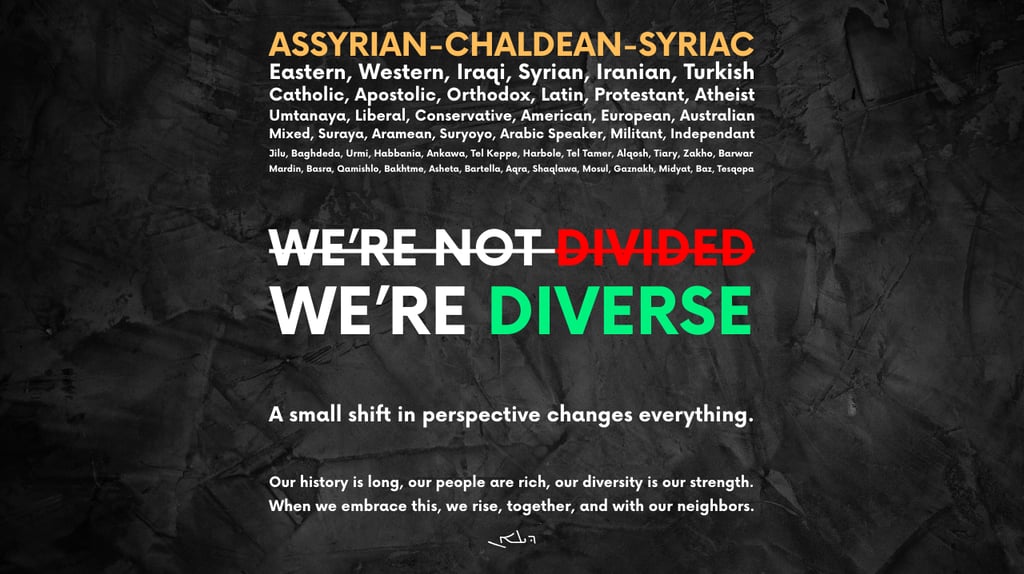
This simple choice of vocabulary makes all the difference once we truly accept what it means. The Assyrian Chaldean Syriac community has been debating its identity, unity, and sense of belonging for decades, if not longer. I hear these endless debates, with no conclusion, whose only effect is to fuel resentment toward one another rather than produce any concrete or useful outcome. We must put an end to this.
To do so, we must first understand the context of this long standing debate. Our population or ethnic group descends from ancient Aramaic speaking peoples of pre Christian Mesopotamia. This geographical territory has been, is, and will always remain the object of desire, conquest, and unfortunately violence, due to its history, location, and strategic resources on a global scale.
It is clearly established that we today descend from Assyrian, Babylonian, and Chaldean peoples who once ruled the region. I will not expand further on this point, as far more qualified scholars have written extensively on our history, and their work is readily available. This is not the core issue here. It is nonetheless important to recall that a large part of these populations converted to Islam and became Arabized over the centuries. From a purely ethnic perspective, this leads us to the reasonable conclusion that the majority of Assyrian descendants today are likely Arabs or Arabized Muslims, particularly in the Mosul region.
Another major complication in our situation is the way this identity debate has been distorted by church denominations. In the absence of a people exercising political control over a defined territory, churches have filled this vacuum and taken part in defining ethnic and communal identity, a role that is normally played by public or civil authorities in most nations. Our church, originally known as the Church of the East, gradually and unfortunately fragmented into several churches whose names were borrowed from civilizations that predate Christianity itself. This is almost paradoxical. In my view, the Assyrian Church and the Chaldean Church would be more accurately named the Church of the East and the Catholic Church of the East. Such terminology would better reflect what they truly are and would help clearly separate religious affiliation from identity debates. Understanding this also allows us to put clerical discourse into perspective. Clergy are not the political leaders of our community. They are the shepherds of our faith. We must distinguish religious discourse from historical analysis, without falling into reactionary responses that contribute nothing to our cause.
Once this is said, it becomes clear that religious differences are only one aspect of the variations within our population. We include people from plains and from mountains. Urban populations and more rural ones. We have dozens of villages and a wide range of dialects, estimated at around one hundred and fifty, depending on how one defines the boundary between a dialect and a language. This question of scale is essential. Broadly speaking, our population includes western groups known as marwaya and eastern groups known as madnhaya, sometimes referred to as Syriac or Suryoyo on one side, and Assyro Chaldean or Suraya on the other. A significant part of our population has also become Arabized. For them, belonging to our community is more a matter of religion and territory than language, and that is perfectly valid as well. Here again, these are not divisions but nuances.
Beyond this original diversity, we have acquired new forms of diversity over time, particularly since the last century. Emigration has created additional branches within our already diverse community. Distinct identities have emerged in the diaspora, such as people from Tel Keppe in Detroit, from Urmia in California, or from Ankawa in Eskilstuna. Each of these communities is shaped both by its original identity and by individual and collective trajectories at a given time and within a specific context. In some cases, these trajectories have reinforced certain aspects of identity, such as Assyrian nationalism in the United States, a strong Chaldean identity in Michigan, or blended European and Australian cultural influences elsewhere.
Does this mean that we are divided. Perhaps. But this is not a problem at all. On the contrary, it is an extraordinary source of richness. These are not divisions but diversity. We often fall into the simplistic expectation that our entire community should present a single identity, a single narrative, and similar political views. This makes no sense. A credible nation can only exist by embracing diversity of opinions and identities within it. By oversimplifying the identity debate, we ignore a fundamental characteristic of modern human beings, namely free will. We also forget that all these labels and affiliations were shaped by our internal history and by external forces that affected us over centuries.
There are therefore two essential points to understand. First, that all these nuances are not divisions but a diversity that constitutes a richness we must value rather than fight. Second, that this diversity does not prevent us from being one community in reality, often referred to in our own language as suraye, with perhaps blurred boundaries and multiple names. This is what matters most. We are together, rich and nuanced. These debates would not even exist if our unity were not self evident. One only debates within a family, not with strangers.
So let us not forget that a simple semantic shift offers us an entirely different way of understanding our situation. This nuance is not trivial. It is a vital condition for our survival. We are no longer numerous in the Middle East, and our identity naturally fades across generations in the diaspora. If we make the effort to engage in dialogue and accept our diversity, we can thrive and grow. I appeal to your conscience and to your sense of responsibility.