
Preserving Ankawa’s Consulate District Is a Moral Obligation
12/18/20253 min read
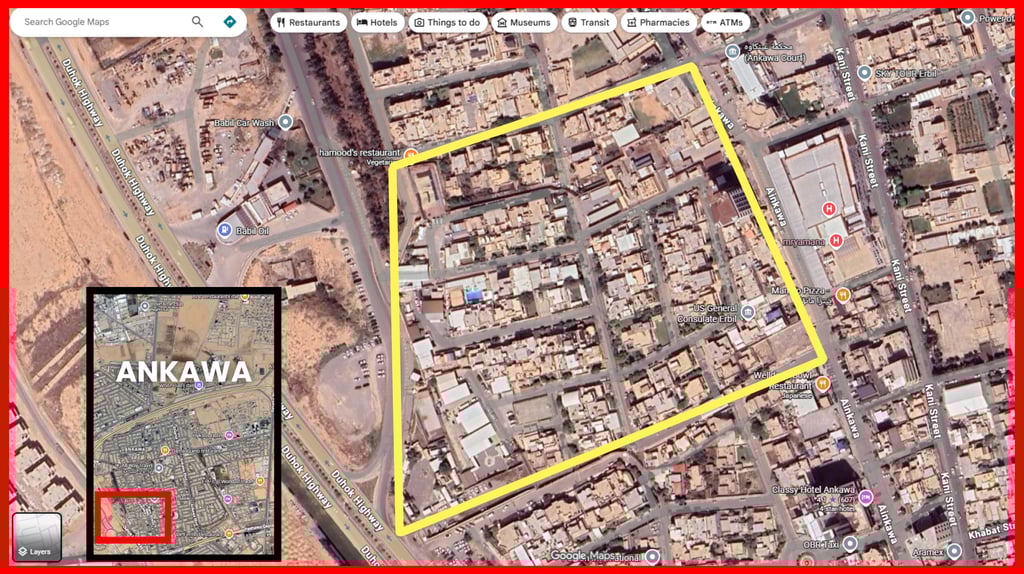
As the American Consulate prepares to move into its new compound built from the ground up and reportedly costing close to one billion dollars on the Shaqlawa road, an entire historic part of Ankawa is about to reappear before the public. This area, preserved from recent construction waves, represents a rare urban fragment that must be protected in the months and years ahead.
Since the early 2000s, the American Consulate in the Kurdistan Region of Iraq and other affiliated American entities progressively settled in the southern part of Ankawa. The area was likely seen as both interesting and strategic due to its Christian population and its proximity to the airport. Over time, American entities rented house after house in this neighborhood, eventually enclosing it behind massive concrete walls for security. A small American fortress emerged in the very heart of our native village. Later, following the 2015 attack near O’Caffe, the main street of Ankawa that once led directly to Erbil was completely closed to traffic.
This neighborhood holds a particular value for many original residents of Ankawa, and for myself as well. I remember our trips in the 2000s when I was a teenager, visiting family during the summer, with many relatives living in this area. My earliest memories of Ankawa are rooted there. The houses were large and so were the gardens. Plots often ranged from four hundred to one thousand square meters, a more than comfortable size. Neighbors knew one another, and only residents drove through the streets.
Meanwhile, the city of Ankawa, like Erbil, underwent deep changes, often in an even more chaotic manner. After the end of the embargo, land and housing prices exploded, and the real estate market became increasingly irrational, until the arrival of ISIS in 2014 disrupted everything once again.
In practical terms, many large family homes were demolished and replaced with small attached houses designed for rental purposes. Numerous buildings were constructed, often excessively large and sometimes hosting immoral activities. Most importantly, the traditional eastern architectural style, shaped by generations of adaptation to environmental constraints, was abandoned in favor of simple constructions that were poorly insulated, low cost, unsustainable, and visually unappealing.
The consequences are clear. Population density in Ankawa has increased beyond the city’s capacity to absorb it. Architectural identity has been almost entirely lost. Urban planning regulations have often been ignored, and sidewalks are largely unusable due to illegal encroachments. The excessive number of shops and restaurants now attracts more visitors from outside the city each day than residents themselves.
Within this urban chaos, the inhabitants of Ankawa will return to this neighborhood once the American tenants have left. They will rediscover a territory seemingly frozen in time, with the same large family homes built in the previous century. The constructions are often of high quality, sometimes even made of brick. This neighborhood also represents a profound shift in local urbanism and architecture. It was among the first areas to feature permanent structures, following centuries of life in mud houses. That period also coincided with a transition in professional activities, as agriculture declined and employment in industry and services increased.
I appeal here to our collective conscience. We must all work together to preserve this neighborhood. It stands as the last symbol of a prosperous and peaceful Ankawa, a city loved by its inhabitants and shielded from prostitution and other activities harmful to the local population. Of course, each property owner will face their own economic and family considerations when deciding what to do with their house after the Americans leave. Yet after nearly twenty years of substantial rental income, we can all make an effort to avoid constructing apartment buildings, to avoid turning these beautiful homes into small flats, and to avoid dividing spacious and airy plots into yet another anonymous street where residents would be tightly packed together.
The American Consulate neighborhood in Ankawa is more than a residential area. It is the symbol of a possible alternative for Ankawa, a city that is harmonious and respectful of its history and its people. Let us protect it.